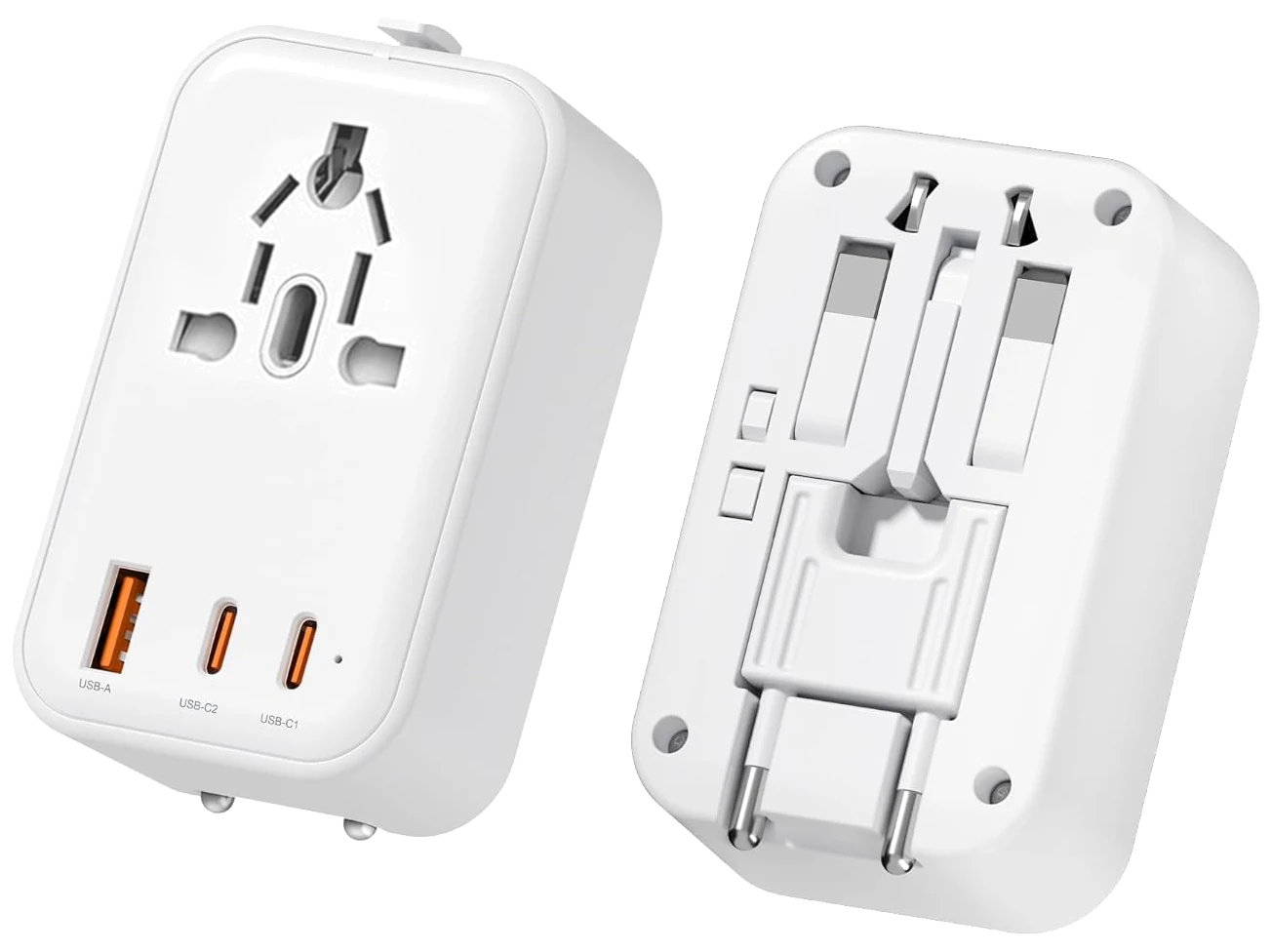
A flat travel adapter uses a thinner product architecture to reduce unnecessary projection from the wall, improve luggage storage and help keep more product mass closer to the plug connection.

A thinner body can reduce how far the product extends from the wall.
Flatter proportions can fit more naturally beside chargers, cables and travel accessories.
Efficient internal packaging can help move heavy components closer to the plug side.
Flat architecture gives brands a visible design story beyond adding more USB ports.
| Design Factor | Traditional Cube | Flat Architecture |
|---|---|---|
| Body thickness | Typically greater | Designed to be reduced |
| Distance from wall | Often farther | Can be closer |
| Center of gravity | May sit farther outward | Can be positioned closer to the wall |
| Travel storage | Block-like volume | Potentially easier to pack |
| Internal engineering | More depth available | Requires tighter packaging and component planning |
| Stability potential | Depends on weight and socket grip | Can improve when plug geometry and mass distribution are also optimized |
Reducing thickness creates engineering tradeoffs. USB-C power modules, plug mechanisms, grounding paths, shutters and thermal structures still need sufficient space and safe clearances.
A travel adapter behaves like a small cantilevered mass when plugged into a wall. The farther the center of mass sits from the wall, the more turning force the product can create around the plug connection.
A flatter design can help by shortening this distance, but actual wall stability still depends on total weight, plug geometry, pin tolerances and the wall socket itself.
Best suited to compact phone-focused platforms where the electronics and thermal system are relatively small.
Requires more careful internal layout to support tablets and selected laptops without increasing thickness excessively.
High-power USB-C brings the greatest packaging and thermal challenge. GaN can help improve power density, but mechanical balance still matters.
The right target thickness depends on power level, grounding, plug architecture, safety requirements and target retail positioning.
LONGRICH develops compact travel adapter platforms around efficient multi-country plug layouts, reduced body thickness, easier packing and improved weight distribution. The objective is to create travel products that feel more portable and better balanced without sacrificing functional plug architecture or charging capability.
It is a travel adapter designed around a thinner body architecture to reduce wall projection and improve portability while retaining international plug and charging functions.
They can be, because reducing the distance between the product mass and the wall can reduce leverage. Stability still depends on the complete product and wall socket.
Yes, but higher power makes packaging and thermal design more difficult. GaN can improve power density, while the mechanical design must still manage heat, plug mechanisms and safety clearances.
It can affect available internal space, so the grounding path must be deliberately engineered rather than treated as an afterthought.
Thickness targets can be evaluated as part of an ODM project together with charging power, plug layout, grounding and safety requirements.
No. It describes product architecture and form factor, not a separate electrical or plug standard.